Insulating exterior walls is one of the more involved retrofits a homeowner can undertake, primarily because the existing wall assembly determines which approaches are feasible without major disruption. In new construction, the choice of insulation material and placement is made at the design stage; in existing homes, the options narrow considerably depending on whether the work is approached from the interior or exterior.
This guide covers the most commonly used materials in Canadian residential wall assemblies, along with the conditions under which each performs well — and the ones where it does not.
Fiberglass Batts
Fiberglass batts are the most widely installed wall insulation material in Canadian residential construction, largely because of their low upfront cost and ease of handling. They come in standard widths designed to fit between 2×4 and 2×6 wall studs and carry R-values of roughly R-13 to R-21 depending on thickness and density.
The primary limitation is installation quality. Batts that are compressed, torn around electrical boxes, or left with gaps along the top and bottom plates provide substantially less thermal resistance than their rated value suggests. They also do nothing to address air leakage — a separate concern that requires caulking or sealing at the framing before the batts are installed.
In a standard 2×6 wall, properly installed fiberglass batts typically achieve R-19 to R-22. The National Energy Code of Canada requires higher effective thermal resistance in colder climate zones, which means batts alone may not meet current requirements without supplementary continuous insulation on the exterior.
Moisture Considerations
Fiberglass is not a moisture barrier. In climates with cold winters — which describes most of Canada — a vapour retarder placed on the warm side of the insulation (typically the interior face of the stud cavity) is standard practice to prevent moisture migration from conditioned space into the wall assembly. Without this, condensation can form within the cavity during winter, leading to mould and structural deterioration over time.
Rigid Foam Board
Rigid foam panels — typically expanded polystyrene (EPS), extruded polystyrene (XPS), or polyisocyanurate (polyiso) — are most commonly used as continuous insulation on the exterior face of the wall sheathing. This placement has a meaningful advantage: it reduces thermal bridging through the studs, which can account for 20–25% of heat loss through a framed wall assembly even when the cavities are well insulated.
XPS is frequently used in Canadian conditions because it retains R-value at low temperatures more consistently than EPS and has a low water absorption rate, making it suitable for below-grade applications as well. Its nominal R-value is approximately R-5 per inch.
Polyisocyanurate has a higher R-value per inch (nominally R-6 to R-6.5) but its effective performance in cold weather is lower — a phenomenon caused by the blowing agents used in manufacturing. This makes it better suited to mixed or warm climates than to the heating-dominated conditions found in most of Canada.
Installation at the Exterior
Adding continuous insulation to the exterior typically requires removing and re-installing siding, extending window and door jambs, and using longer fasteners for cladding attachment. The thickness of foam that can be practically added is often limited by these secondary constraints rather than by cost. Even 50mm (2 inches) of exterior foam makes a measurable difference in whole-wall R-value and substantially reduces thermal bridging through studs.
Spray Polyurethane Foam
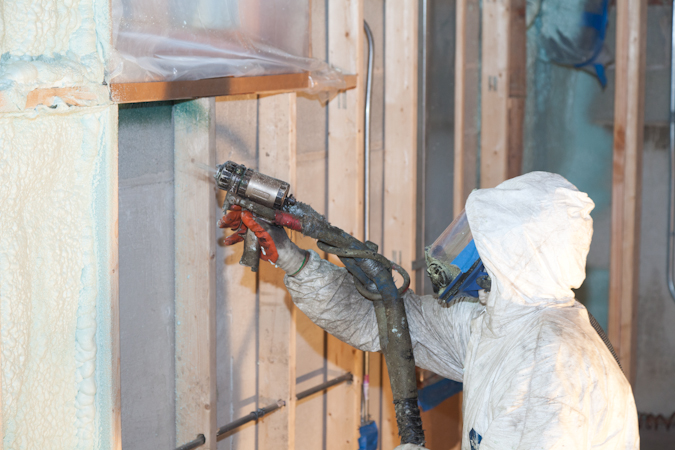
Spray foam is available in two formulations: open-cell and closed-cell. The two behave differently and are appropriate in different situations.
Closed-cell spray foam has a high R-value per inch (roughly R-6 to R-7), is impermeable to moisture, and acts as both an air barrier and a vapour retarder. It adheres directly to framing members and sheathing, adding structural rigidity to the wall. In wall cavities, a partial fill of closed-cell foam can meet the moisture control requirements of a cold climate without a separate vapour retarder, although this depends on the specific zone and assembly details.
Open-cell spray foam has an R-value closer to R-3.5 per inch and is permeable to moisture vapour. It performs well as an air barrier but does not function as a vapour retarder, meaning it still requires a separate membrane on the interior side in cold climates. It is less expensive than closed-cell and expands significantly during installation, making it useful for filling irregular cavities and sealing around penetrations.
Blown-In Cellulose
Cellulose insulation is made from recycled paper treated with borate-based fire retardants. When blown into wall cavities through drilled holes (a method known as dense-pack), it fills the cavity completely, including around wiring and framing irregularities that batts often bridge imperfectly.
Dense-pack cellulose achieves an R-value of approximately R-3.5 per inch. In a 2×6 wall cavity, that yields roughly R-20 with full-depth fill. Its air resistance is notably better than loose batts, though it still requires attention to vapour control in cold climates.
This method is practical as a retrofit because it can be installed from the exterior by drilling through siding, injecting cellulose, and patching — without opening up interior walls. The quality of the installation depends heavily on achieving consistent density throughout the cavity, typically verified by weight calculations based on the product's rated settled density.
Choosing a Material for a Retrofit Project
For existing homes where walls are not being opened, dense-pack cellulose or spray foam (injected through drilled ports) are typically the practical options. For walls being opened as part of a renovation, any of the above materials can be used, often in combination — for example, fiberglass or cellulose in the cavities with continuous rigid foam on the exterior.
The appropriate choice depends on the specific climate zone, the existing assembly, budget, and whether the exterior cladding is being replaced at the same time. Natural Resources Canada's homeowner resources provide zone-specific guidance on minimum and recommended insulation levels by assembly type.